TERMS & CLASSIFICATION
Nicotine Pouches, Snus and NRT: Three Categories, Different Evidence
Nicotine pouches, snus and nicotine replacement therapy (NRT) should be described separately. The first distinction is whether a product contains tobacco leaf. The second is whether it is a medicine evaluated for smoking cessation. A similar-looking pouch or a shared ingredient does not make the evidence interchangeable.
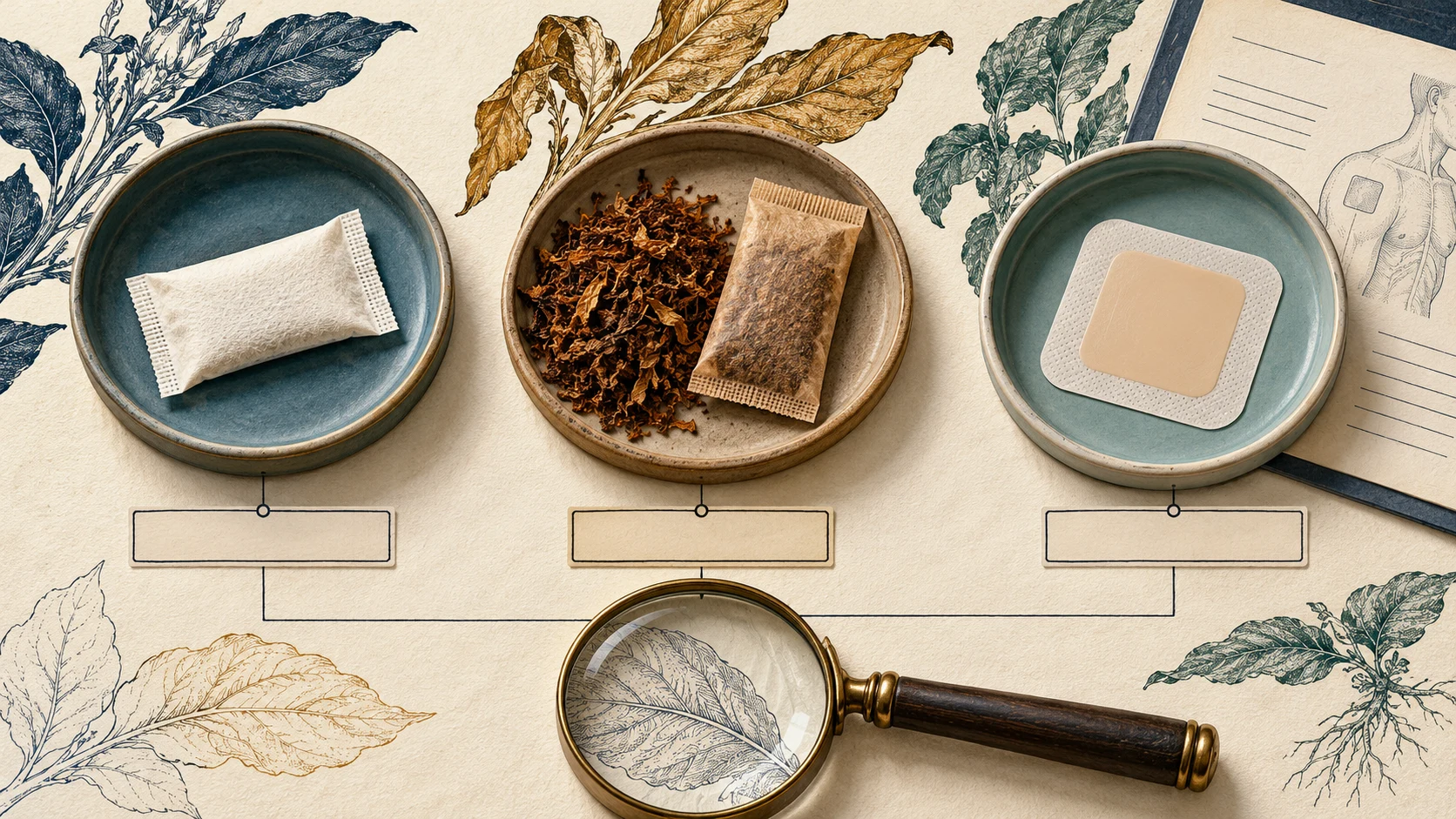
What distinguishes the three categories?
Nicotine pouches: nicotine without tobacco leaf
CDC describes nicotine pouches as fiber packets containing nicotine and other ingredients, without tobacco leaf. Their nicotine can come from tobacco or chemical synthesis. The absence of leaf therefore does not mean the absence of nicotine. CDC also identifies nicotine as addictive. [1]
Snus: an oral tobacco category
Snus belongs to smokeless tobacco. The National Cancer Institute describes snuff as finely cut or powdered tobacco, sometimes supplied in small pouches. Its discussion of tobacco-specific nitrosamines concerns tobacco-containing products. That evidence should not be relabeled as a direct measurement of every leaf-free pouch. [2]
NRT: a treatment category
NRT refers to medicinal nicotine used for smoking cessation. FDA lists patches, gum and lozenges among over-the-counter forms, and nasal spray and inhalers among prescription forms. Classification depends on the specific product and intended medical use, not simply the presence of nicotine. [3]
| Category | Defining distinction | Evidence to look for |
|---|---|---|
| Nicotine pouch | Nicotine-containing, without tobacco leaf | Research on that pouch formulation and outcome |
| Snus | Tobacco-containing oral product | Research on the relevant tobacco product |
| Medicinal NRT | Smoking-cessation medicine | Medicine labeling and cessation trials |
How should ambiguous terms be read?
Describe the object before interpreting its health claims. A useful record separates composition, nicotine origin, physical format and medicinal status into different fields. Leaving those fields separate makes contradictions visible: a leaf-free description answers a composition question, while a cessation claim answers a treatment question.
- Tobacco-leaf-free: a statement about leaf content; it does not establish nicotine absence.
- Synthetic nicotine: a statement about origin; it does not establish that a finished product has been clinically evaluated.
- Smokeless: a description of how a product differs from combustion; it is not a complete assessment of health effects.
- Nicotine-free: a separate composition claim that should not be inferred from packaging color, pouch appearance or the word “white.”
These are distinctions for reading information accurately, not a ranking of products. A scientific summary should identify the actual category before it discusses dependence, toxicant exposure or treatment outcomes.
Why NRT evidence cannot be transferred to nicotine pouches
A 2018 Cochrane review found that the licensed NRT forms it evaluated increased the chances of stopping smoking by approximately 50–60% relative to control. This is a relative improvement in cessation outcomes, not a 50–60 percentage-point increase and not a finding about commercial nicotine pouches. [4]
That distinction matters whenever a page cites a recognized health organization. A reference to NRT research cannot, by itself, establish that another nicotine-containing product has the same treatment benefit. The intervention, participants, comparator and outcome must match the statement being made. For an evidence-reading framework, see how to interpret nicotine-pouch research.
What does an FDA authorization actually establish?
FDA distinguishes authorization to sell a tobacco product from an assertion that it is safe or “FDA approved.” Its nicotine-pouch information explicitly warns against treating authorization as a safety endorsement. A medicine approval and a tobacco-product authorization answer different questions. [5]
When checking a claim, write down the issuing agency, the exact product and the type of decision. A statement about a named product should not silently become a statement about an entire category, a different manufacturer or every country. This article explains terminology; it does not determine the legal status of any product.
Frequently asked questions
Are nicotine pouches the same as snus?
No. Nicotine pouches contain nicotine without tobacco leaf; snus is a tobacco-containing oral product. Similar packaging does not make their composition or evidence identical.
Does synthetic nicotine mean nicotine-free?
No. Synthetic describes the origin of the nicotine. It is not a claim that nicotine is absent.
Can a nicotine pouch be assumed to be medicinal NRT?
No. A shared ingredient or oral format does not establish medicinal status. Check the specific product’s approved medicine information rather than borrowing evidence from another category.
References and source dates
Original sources were checked on 22 October 2026. Research periods are stated in the text; checking a source today does not change the period its data describe.